Interesting article from BBC about the Archbishop of Cantebury speaking about teaching Creationism in schools.
http://news.bbc.co.uk/1/hi/education/4828238.stm
From the article:
Dr Williams [Archbishop] said: "I think creationism is, in a sense, a kind of category mistake, as if the Bible were a theory like other theories.
"Whatever the biblical account of creation is, it's not a theory alongside theories. It's not as if the writer of Genesis or whatever sat down and said: 'Well, how am I going to explain all this... I know: in the beginning God created the heavens and the earth'.
"So if creationism is presented as a stark alternative theory alongside other theories I think there's just been a jarring of categories. It's not what it's about."
Asked if it should be taught, he said: "I don't think it should, actually. No, no. And that's different from saying - different from discussing, teaching what creation means.
"For that matter, it's not even the same as saying that Darwinism is - is the only thing that ought to be taught. My worry is creationism can end up reducing the doctrine of creation rather than enhancing it."
Interesting thought. I happen to agree with him that Creationism, or Intelligent Design, shouldn't be taught in schools and I think his reasoning is spot on here. Would it reduce the doctrine of creation? I think it might. Because as the Archbishop carefully notes, it is "different from discussing, teaching what creation means." Its not just that it happened in a specific way, but that it happened as the very specific will of a very specific person. Not to discount the way it happened, which may be important, but I also tend to agree that this would be a category mistake. The writer of Genesis is making a different point here.
My favorite books on Genesis:
In The Beginning: The Opening Chapters of Genesis - Henri Blocher
The Five Books of Moses - Robert Alter
Genesis: Interpretation - Walter Brueggemann
Tuesday, March 21, 2006


My Friend Stephan
My friend Stephan and his family (wife Belinda, sons Joshua and Caleb) are currently living in Rwanda where he is the National Director for World Relief. Stephan used to be the Director of International Programs for World Hope International where I worked during my Falls Church Fellows year. I got to know Stephan pretty well that year as we loved to kick back and talk theology, music, life, love, and dream of the perfect church together.
Every once in a while, they send out an update of their work in Rwanda. They are short, but always full of joy and hope. Here is a link to a few blogs that Stephan keeps up (when he can) but I hope that they point you to the work that people are doing with God around the world.
baumans.blogspot.com
underthemango.blogspot.com
I'm glad there are people like Stephan and Belinda working for reconciliation in Rwanda.
Saturday, March 18, 2006
This is a keeper...
This quote was sent by a friend. I promise I'm not reading books about marriage...but this quote is a good one to think on...
"God never sends just one sign: He keeps on confirming His course for
us with one vision after another. But the reading of His signs is
essentially a task for faith, a task for people who are willing to
persist in seeking out the correspondence between the external and
visible realities of their lives, and the interior weather of their
souls, striving always to bring the two into line in order that the
kingdom of God might come."
- Mike Mason, "The Mystery of Marriage"
Thanks Meghan :)
Simply Wonderful
Ok, I've read the first chapter of Simply Christian and I have to report what I read...It was amazing. Much like Mere Christianity, the book begins by appealing to our desires. Part one is entitled Echoes of a Voice, and the first of the four chapters is entitled Putting the World to Rights. In this chapter, again like Lewis, Wright points to our innate desire for justice, to children on a playground yelling, "That's not fair!", to a sense of there being something wrong with the world. This of course doesn't immediately point to the Christian God but Wright is setting the groundwork for how Christianity actually answers these desires and in fact, in a way, is the cause of them.
Here are some excerpts that I enjoyed:
"We dream the dream of justice. We glimpse, for a moment, a world at one, a world put to rights, a world where things work out, where socieities function fairly and efficiently, where we not only know what we ought to do but actually do it. And then we wake up and come back to reality. But what are we hearing when we're dreaming the dream?" pg. 3
"There are three basic ways of explaining this sense of the echo of a voice, this call to justice, this dream of a world (and all of us within it) put to rights....We can say that it is indeed only a dream...Down the road we find Machiavelli and Nietzsche, the world of naked power and grabbing what you can get, the world where the only sin is to be caught....
Or we can say that the dream is of a different world altogether, a world where we really belong, where everything is indeed put to rights, a world into which we can escape one day for good--but a world which has little purchase on the present world except that people who live in this one sometimes find themselves dreaming of that one. That approach leaves the unscrupulous bullies running this world, but it consoles us with the thought that things will be better somewhere, sometime, even if there's not much we can do about it here and now....
Or we can say that the reason we have these dreams, the reason we have a sense of a memory of the echo of a voice, is that there is someone speaking to us, whispering in our ear--someone who cares very much about this present world and our present selves, and who has made us and the world for a purpose which will indeed involve justice, things being put to rights, ourselves being put to rights, the world being rescued at last." Pg. 9
"It's about justice because Christians not only inherit the Jewish passion for justice but claim that Jesus embodied that passion, and that what he did, and what happened to him, set in motion the Creator's plan to rescue the world and put it back to rights." Pg. 10
The book is full of other quotable sentences and paragraphs, but just to make sure I'm not in violation of copyright laws I better leave it there.
Wednesday, March 15, 2006
Simply Christian
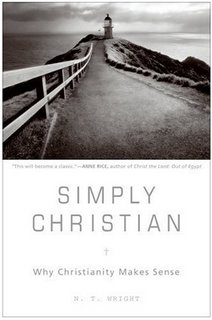 Grab your to-do lists and a pencil and under your last item "stop making to-do lists", write "buy new NT Wright book". This book was just released yesterday and if you are so out of touch with pop culture that you actually follow the Christian book publishing dates, then you probably already know about this. But for the rest of you get excited...
This little book is NT Wright's latest contribution to trying to increase the amount of good, recommendable books in the Christian section of the bookstore. To compare it to another Oxford/Cambridge giant who also uses initials, one of the blurbs describes it as, "a Mere Christianity for a new generation from a leading Christian scholar and Anglican bishop". I'm not sure that really is enough to do justice to what this book could be, and who NT Wright is. So, I will try to fill in the gaps for anyone who cares...
Here is what the back cover offers to casual readers in the bookstore:
Why is justice fair? Why are so many people pursuing spirituality? Why do we crave relationship? And why is beauty so beautiful? N. T. Wright argues that each of these questions takes us into the mystery of who God is and what he wants from us. For two thousand years Christianity has claimed to answer these mysteries, and this renowned biblical scholar and Anglican bishop shows that it still does today. Like C. S. Lewis did in his classic Mere Christianity, Wright makes the case for Christian faith from the ground up, assuming that the reader is starting from ground zero with no predisposition to and perhaps even some negativity toward religion in general and Christianity in particular. His goal is to describe Christianity in as simple and accessible, yet hopefully attractive and exciting, a way as possible, both to say to outsiders “You might want to look at this further,” and to say to insiders “You may not have quite understood this bit clearly yet.”
Wright has done more for my intellectual and spiritual life than any other Christian thinker out there. I have learned more about the faith I claim as my own from him than I have from almost every other writer I've read. And here is the 'about the author' blurb:
N.T. Wright is Bishop of Durham and was formerly Canon Theologian of Westminster Abbey and dean of Lichfield Cathedral. He taught New Testament studies for twenty years at Cambridge, McGill, and Oxford Universities. Wright's full-scale work, Jesus and the Victory of God, is widely regarded as one of the most significant studies in the contemporary Third Quest of the historical Jesus. It follows The New Testament and the People of God as the second volume in his projected six-volume series entitled Christian Origins and the Question of God. Among his many published works are: The Challenge of Jesus, The Meaning of Jesus (coauthored with Marcus Borg), and What Saint Paul Really Said.
OK, so now that that is unpacked a little, let me try to do my best to persuade you to read this book and/or offer it to people you know to read. Mere Christianity was probably one of the 5 most important things that ever happened to me. I don't remember where I got it and I don't remember ever wanting to read it, but for some reason I found myself for a week straight in my room, alone, reading through it. I was a junior in college and my life wasn't really what I wanted it to be. I would say that I was depressed but I don't think it was that serious, just a tendency I have to be a little melancholy. At the time I wasn't a reader, in fact it may have been the first book I ever read outside of school. That book changed me. I looked at the world in a new way after putting that book down. The last paragraph is what put the last nail in the coffin for the old Dude:
"But there must be a real giving up of the self. You must throw it away blindly so to speak. Christ will indeed give you a real personality: but you must not go to Him for the sake of that. As long as your own personality is what you are bothering about you are not going to Him at all. The very first step is to try to forget about the self altogether. Your real, new self (which is Christ's and also yours, and yours just because it is His) will not come as long as you are looking for it. it will come when you are looking for Him. Does that sound strange? The same principle holds, you know, for more everyday matters. Even in social life, you will never make a good impression on other people until you stop thinking about what sort of impression you are making. Even in literature and art, no man who bothers about originality will ever be original: whereas if you simply try to tell the truth (without caring twopence how often it has been told before) you will, nine times out of ten, become original without ever having noticed it. The principle runs through all life from top to bottom. Give up yourself, and you will find your real self. Lose your life and you will save it. Submit to death, death of your ambition and favorite wishes every day and death of your whole body in the end: submit with every fiber of your being, and you will find eternal life. Keep back nothing. Nothing that you have not given away will be really yours. Nothing in you that has not died will ever be raised from the dead. Look for yourself, and you will find in the long run only hatred, loneliness, despair, rage, ruin and decay. But look for Christ and you will find Him, and with Him everything else thrown in." -CS Lewis, Mere Christianity
So that was it for me. I was never really the same person. A long series of events has brought me to where I was today, but Mere Christianity was the beginning.
I would like to think that this book could be a new Mere Christianity for a generation that needs to hear a fresh presentation of the Gospel. Like Lewis, Wright deals with philosophical questions in beautifully simple style but he goes one step further that Lewis was able to do in his context. Wright has long been a voice for social justice and the Christian vocation of being called to be where the world is in pain, at the place where the world is suffering and in a state of shame and sorrow. He also, for me at least, articulates God's new creation better than anyone else and the hope of the Kingdom of Heaven on earth, not some far-off-floatinig-soul diembodied Heaven we tent to speak of.
I think that this book will speak to a generation that sees the pain in the world like never before. It will speak to those who think the Church has nothing to say to global injustice. It will speak to those who read Mere Christianity. It will speak to those who have never heard the gospel of Jesus and the Kingdom. With Wright's brilliant mind and beautiful prose, there are sure to be people for generations citing this book as the beginning of something new in their lives. At least, that is what I would like to think...
Go read this book and give it away to someone that needs it. You won't be dissappointed and neither will they.
***The Dude just got a copy yesterday and has only read the first chapter. Any and all predictions are completely speculation, although The Dude believes very strongly that it will be an important book for years to come. Plus, the cover is badass.
Saturday, March 11, 2006
I could definitely live here....

Vancouver, BC

Regent College

Sure beats Waco

I think this picture was taken on July 13th

I don't know when this one is from...
Friday, March 10, 2006
Good Genes
 My brother recently discovered my blog. Well it turns out that blogging doesn't set me apart in the Flynn family. A few years ago my brother was involved in little project called Catholic Hoops. Here is the biography that is included at the bottom of the blog:
Sean Flynn: The driving force behind Catholic Hoops, he is neither Catholic nor a basketball player. Born to an Irish Protestant father and a Jewish mother, he was baptized Christian but remains Jewish under Jewish law. Bridging these cultures while growing up in Houston, Flynn grew an uncommon fondness for East Coast basketball. He oversaw the John Thompson retirement while completing his studies at Georgetown University.
I admire my brother for a lot of things not least of which is his ability to write. I always wished I could write as well as he could but I'm not sure I'll ever get there. It's not that fair of a race though...he does have 18 months on me, an education from a prestigious school, plus he's smarter, and he was reading the sports page at age 3...so he's got that going for him. Anyway, here is my favorite article my brother wrote while he was in college, I think you'll find it entertaining:
School's Out Forever
The picture above, which is from that article, is of Sean (Son of Cary Flynn) on the Left, David Noll (Son of Mark Noll) center, and the cool guy on the right is yours truly.
Sean's articles can be found here: The Washington Post.
Thursday, March 09, 2006
Sure, I was a student....but I wasn't a student
So I was doing a wikipedia search on the word Iconoclast. Read below and see if you think its as funny as I do.
An iconoclast originally referred to a person who destroyed icons, that is, sacred paintings or sculpture. An example is Byzantine emperor Leo III, who ordered the destruction of all icons of Jesus, the Virgin Mary, and the Saints in his empire. For more discussion of historical iconoclasts, see iconoclasm.
The more common meaning in current usage is that an iconoclast is a person who carries out symbolic or quixotic acts of protest against authority figures, the connotation being that the iconoclast opposes the imposition of authority itself rather than any particular policy or action.
The term may also refer to a person who reacts against popular culture or ideals.
Iconoclast was also a Southern Californian anarcho-punk band from the 1980s. It is also the name of a Sundance Channel show where ground-breaking celebrities are interviewed. In the 1890's Iconoclast was the name of a major Texas newspaper known for being critical of powerful institutions and figures. The newspaper ceased to exist when the editor was shot in the back for exposing scandelous activities at Baylor University.
Everyting is coming together now. It starts out with good intentions and ends with a shooting at Baylor University.
Tuesday, March 07, 2006
Sabbath
What is the Sabbath?
In the Christian West we mark Sunday as being the Sabbath. For the Jews the Sabbath is Saturday. Did the Sabbath change? The way I understand it is that the Sabbath is represented by the last day of the week (Saturday) to reflect Yahweh resting on the seventh day of Creation. Christians moved the holy day to Sunday to mark the celebration of Christ's resurrection, but I'm not sure they actually moved the Sabbath. Correct me if I'm wrong here.
Yesterday morning in Bible study we looked at John 5. There is the story of Jesus healing the invalid at the pool on the Sabbath and then a long exposition by Jesus about who he is, testimonies, and how they need to believe God, who sent Jesus, which the scriptures clearly point to.
Here is what caught my attention this morning:
So, because Jesus was doing these things on the Sabbath (healing the invalid), the Jews (the word used here specifies that the 'Jews' are Judeans) persecuted him. Jesus said to them, "My Father is always at his work to this very day, and I, too, am working." For this reason the Jews tried all the harder to kill him; not only was he breaking the Sabbath, but he was even calling God his own Father, making himself equal with God.
My Father is always at his work to this very day, and I, too, am working.
I think Jesus is challenging the Jews idea of the Sabbath here and hopefully our ideas of the Sabbath as well. We typically think of Sabbath as the day of rest. Which is not incorrect; it is the day of rest for Jews, Christians, and Muslims (although all 3 practice on different days, in different ways). But what does it mean to rest? I think the first place we would normally look would be Genesis 2 or perhaps the 10 commandments . It does clearly say there in both Exodus and Deuteronomy that the Jews were to do no work. God did all his work during the first 6 days and then rested, and so shall they. A (perhaps major) difference between the two texts is that in Deuteronomy, Moses adds this: Remember that you were slaves in Egypt and that the LORD your God brought you out of there with a mighty hand and an outstretched arm. Therefore the LORD your God has commanded you to observe the Sabbath day.
So we can see the Sabbath as a day set aside to reflect on the story of the people of God. We are not to work, we are to rest in creation as God rests and remember what God did at the Exodus. But I'm not so sure that works when we play the Jesus card.
Jesus didn't have to heal the man on the Sabbath. He had been sick for 38 years and one more day wouldn't have hurt him. But it looks like Jesus deliberately chooses this day(or at least the day chose him). And Jesus doesn't even do any work he simply tells the man to pick up his mat (which is considered work). After this, Jesus' statement about the father working is meant to set a new standard for people to go by. The Sabbath is most certainly not outdated, or useless anymore, but needs a tune-up. It needs to be recreated itself.
First, there are a few other sayings of Jesus that are important here:
-It is lawful to do good on the Sabbath (Matthew 12:12)
-The Sabbath was made for man, not man for the Sabbath (Mark 2:27)
-Now if a child can be circumcised on the Sabbath so that the law of Moses may not be broken, why are you angry with me for healing the whole man on the Sabbath? (John 7:23)
-The Son of Man is Lord of the Sabbath (Mark 2:28 and parallels)
I'm sure there are more and I definitely don't want to take any of these out of context, but I think they are important to understand the 'new' Sabbath.
If we keep in mind the big picture story of Creation, Fall, and Redemption, maybe we can make sense of the Sabbath. In the beginning, God created the world. The world he created 'fell', and Sin is now alive and well. Soon after that God begins his work of redeeming the world and restoring the world to its original glory. Jesus is the climax of the restoration, the victory of God over evil, and the beginning of the new creation.
It's this last point that I want to focus on: new creation. God is making all things new! That sounds like work to me but a very specific kind of work. We see it revealed in Jesus: 'My Father is always at his work to this very day, and I, too, am working' is a redefinition of work and sabbath, i think. God is working on restoring the creation and redeeming it. We are in a different part of the story from when the Sabbath was given but not a new story, as Tom Wright would say. So what does that do to Sabbath rest? Again, I think it redefines it.
"The heart of it seems to be Jesus' belief that Israel's god was then and there in the process of launching the new creation. And somehow this new creation was superseding the old one. Its timescale was taking precedence. God was healing the sorry, sick old world, and though there might come a time for rest (when Jesus' own work was finished, maybe: see John 19.28-30), at the moment it was time for the work of new creation to go forward." - Tom Wright
So, just like these ramblings, there is work to be done. Not work so we can earn our way into heaven, but work because if we believe in the one who was sent from God (or Paul for that matter) we know that we can be participants (in fact we are invited!) in the new creation. Jesus' ministry opens with a reading from Isaiah:
The Spirit of the Lord is on me, because he has anointed me to preach good news to the poor. He has sent me to proclaim freedom for the prisoners and recovery of sight for the blind, to release the oppressed, to proclaim the year of the Lord's favor.
Let us make this our mission statement as Jesus made it his. There is work to be done. There are poor yet to be preached the good news, there are prisoners yet to be set free, there are blind people whose sight is yet to be recovered, there are people yet to be released from oppression. If we want sabbath rest, let us rest in the fact that God is working on making all things new. Let us work with him and rest in the new creation and not settle for anything less.
Wednesday, March 01, 2006
For God's Sake
From a wonderful article by Philip Yancey in Christianity Today:
I've become more convinced than ever that God finds ways to communicate with those who truly seek him, especially when we lower the volume of the surrounding static. I remember reading the account of a spiritual seeker who interrupted a busy life to spend a few days in a monastery. "I hope your stay is a blessed one," said the monk who showed the visitor to his cell. "If you need anything, let us know, and we'll teach you how to live without it."
Subscribe to:
Posts (Atom)


